
Industry 4.0 in Thai Factories: Where to Start (and What to Skip)
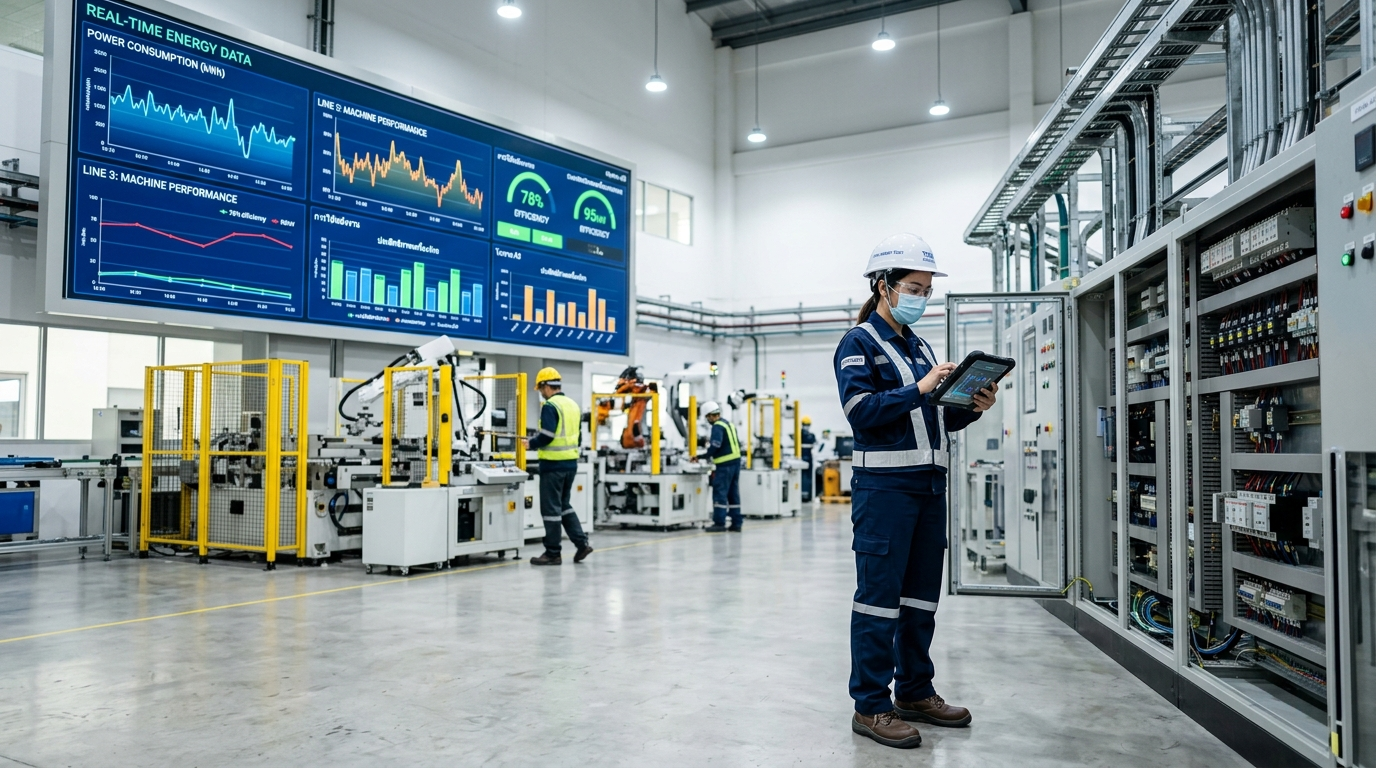
Industry 4.0 is the most over-promised and under-delivered concept in Thai manufacturing. The vision — fully autonomous lights-out factories, digital twins, AI-driven predictive maintenance — is real, but it's arriving one practical step at a time, not as a single transformation project. For most Thai factories, the question isn't "how do we become Industry 4.0?" It's "which piece of technology actually pays back this year?"
This guide is for the Thai plant manager who's been told Industry 4.0 is the future but hasn't been told where to start — and what to skip. It is grounded in real Thai factory conditions: brownfield sites with ageing electrical infrastructure, mixed-vintage machinery, and a workforce that needs tools that work, not PowerPoint roadmaps.
What Industry 4.0 actually means — for a real Thai factory
Industry 4.0's building blocks — sensors, connectivity, data, analytics, automation — reduce to three practical capabilities:
- Seeing what's happening — real-time monitoring of machines, energy, quality and throughput, instead of relying on shift reports written at 6 a.m.
- Understanding why — connecting cause to effect. A spike in energy use isn't just a number; it's traced to a specific motor, a specific shift, or a maintenance event.
- Acting on it — automated alerts, process adjustments, or maintenance triggers, without waiting for a human to notice.
The factories that succeed don't try to do all three at once. They start with seeing, move to understanding, and only automate when the return is obvious. The factories that fail try to automate a process they don't yet understand.
Start here: metering and monitoring (the electrical foundation)
The single highest-return Industry 4.0 step for a Thai factory is installing power and energy monitoring on your main incoming supply and key production circuits. Here's why:
- It pays for itself through tariff management. If you're on a Time-of-Use (TOU) tariff — and most Thai factories above 30 kVA are — knowing when your peaks occur lets you shift flexible loads to off-peak, directly reducing the bill. Every factory we've metered has found at least one shiftable load.
- It finds waste you didn't know existed. A motor drawing 20% more current than its rating? A compressor running unloaded for three hours every shift? You won't see it on a monthly bill; you'll see it on a sub-meter within a week.
- It's the foundation for everything else. Predictive maintenance, energy optimisation, production monitoring — they all need the data layer first. Power monitoring is the cheapest, highest-signal data layer in a factory. We covered the eight most effective levers in our guide to reducing factory energy bills.
Metering doesn't need a shutdown; current transformers (CTs) clamp on around existing cables, and a gateway sends data to a dashboard. It's the one Industry 4.0 step that works on any factory, regardless of machine age or brand.
Second: connect the machines that matter
After metering, the next step is connecting your most important machines. Not every machine — the ones whose downtime costs real money. For most Thai factories, that means:
- Critical production equipment — the line or machine that, if it stops, stops revenue.
- Large motors and pumps — high energy consumers where small efficiency drops become large costs.
- Compressed air and HVAC — the two utilities that quietly consume more than you think.
Modern PLCs already speak industrial protocols (Modbus, Profinet, Ethernet/IP); the data is there, just not collected. A gateway pulls it into the same dashboard as your power data, and suddenly you can correlate machine throughput with energy consumption — the single most useful ratio in a factory.
This is where the ETES + EcoXplore model works naturally: ETES handles the electrical installation and instrumentation, and EcoXplore's platform brings the data together on one screen. One contractor for the wires and the data means one team accountable for both.
Third: tackle predictive maintenance — but only for the right assets
Predictive maintenance (PdM) is the most marketed Industry 4.0 capability, and the most misapplied. Vibration sensors on every pump and motor in the plant is a vendor's dream and a plant manager's budget nightmare.
The right approach for a Thai factory:
- List your assets by criticality. A cooling-water pump that, if it fails, stops production for a day earns a sensor. A secondary transfer pump with an installed spare does not.
- Start with temperature and current. Most electrical failures announce themselves as heat or increased current draw first. A thermal scan of your switchboards under load — combined with current monitoring on critical feeders — catches most failures while they're still cheap.
- Add vibration selectively. Once you've instrumented for heat and current, add vibration monitoring only on assets where the cost of failure justifies it. For most Thai factories, that's 5–15 machines, not 500.
What to skip (for now)
Not every Industry 4.0 technology is right for every factory. Here's what most Thai plants should defer:
- Full digital twins. A 3D virtual replica of your entire plant is spectacular in a demo and unnecessary for most factories. Start with a single-line diagram that matches reality and instrumented data on top of it — that's the practical twin that saves money.
- AI/ML without a data foundation. Machine learning on one year of inconsistent manual logs won't produce useful predictions. Build the data layer first; AI comes after.
- Lights-out automation of an entire line. Automating a single high-ROI process step is smart; trying to automate an entire line at once is how projects fail. Walk before you run.
- Technology that requires a complete electrical upgrade first. Some Industry 4.0 systems demand a level of power quality and UPS backup that your existing MSB and distribution can't support. Solve the electrical foundation before you bolt technology on top of it.
How to start — the 90-day plan
If you do nothing else in the next 90 days, do these three things — in this order:
Week 1–2: Install energy metering. Clamp-on CTs on the main incomer and your top 3–5 production circuits. You'll have actionable data before the month ends. This alone often funds everything that follows.
Week 3–6: Run a thermal scan and a load study. An annual electrical inspection-grade thermal scan of every switchboard under load, combined with a load study of your main distribution. This tells you which boards have spare capacity for new instrumentation and which are already near their limit — the capacity question we covered in our production-line expansion guide.
Week 7–12: Connect your most critical machine. Pick one — the machine whose downtime hurts most — and pull its PLC data into the same dashboard as your power data. You now have the two numbers that matter: energy in, product out.
At the end of 90 days, you'll have a real, instrumented view of your factory's electrical and production performance — not a consultant's report, but live data your own team can act on. That's Industry 4.0, Thai-style: practical, incremental, and paying for itself from month one.
FAQ
Frequently asked questions
Do I need to stop production to install Industry 4.0 systems?
Not for the first two steps. Clamp-on current transformers for energy metering install without a shutdown, and PLC data extraction reads existing signals — no new wiring into control circuits. Thermal scanning is done under normal load. Later steps — like adding a new MSB — may need a planned shutdown window, but by then you'll have the data to justify it.
How much does a basic Industry 4.0 setup cost for a Thai factory?
A meaningful first phase — main incomer metering plus 5 production-circuit sub-meters with a dashboard — typically costs less than a single unplanned production stop. The range depends on factory size and instrumentation needs, but it's measured in thousands, not millions, of baht.
Does my old machinery work with modern monitoring?
Yes — this is one of the few areas where machine age doesn't matter. Current transformers clamp around any cable regardless of the machine behind it. Even vintage motors and pumps can be monitored for current, temperature, and vibration.
How does this connect to my รง.4 inspection?
Continuous monitoring makes your annual electrical inspection a formality rather than a discovery. When the inspector arrives, you have 12 months of trended data showing your electrical system's health — far more convincing than a single day's test. Insurers and the DIW both value continuous monitoring over annual snapshots.
Who should install this — my IT team or my electrical contractor?
Neither alone. The instrumentation (CTs, gateways, power-quality meters) is electrical work — it sits in your switchboards and must be installed by a licensed electrical engineer. The data platform and dashboard are OT/IT. Using one team that does both — like ETES for the electrical layer and EcoXplore for the data platform — avoids the finger-pointing that happens when the electrical contractor blames the software and the IT team blames the wiring.