
MSB vs MDB vs Sub-MSB: Plain-English Guide for Thai Plant Engineers
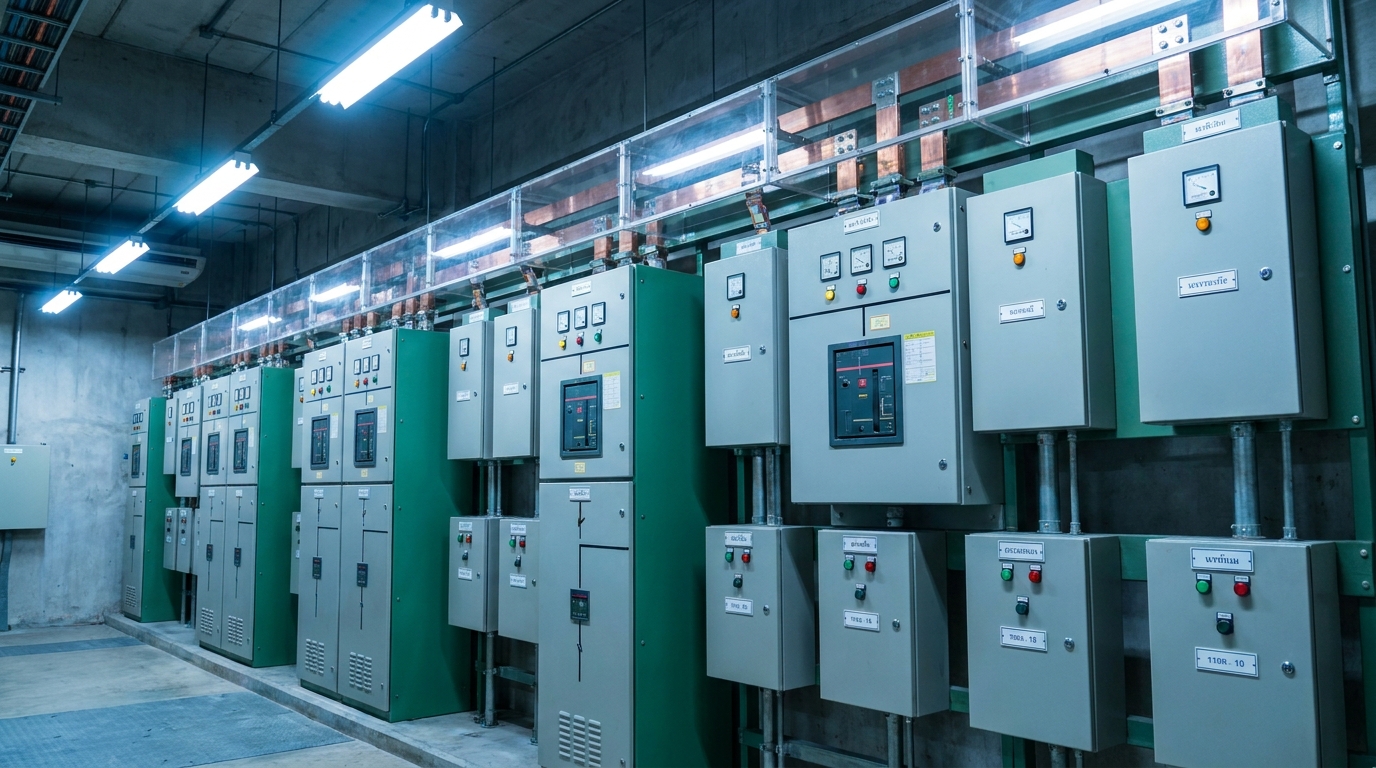
Walk any Thai factory floor and you'll hear the terms used loosely and interchangeably: MSB, MDB, Sub-MSB, DB, panel. They are not the same thing, and getting them straight matters when you're scoping an upgrade, reading a single-line diagram, or asking a contractor for a quote. Here's the plain-English version.
The hierarchy, top to bottom
Think of power distribution as a tree. Utility power (or your generator) comes in at the top, and the switchboards step it down and split it out as you move toward the loads:
- MSB — Main Switchboard. The first board after your incoming supply / transformer. It holds the main incomer (usually an ACB — air circuit breaker), main metering, and the large outgoing breakers that feed everything downstream. It is the heart of the installation; if the MSB is down, the site is down.
- MDB — Main Distribution Board. In Thai practice “MDB” and “MSB” are often used for the same board, but where both exist, the MDB is the primary distribution board fed from the MSB, splitting power to different zones or buildings.
- Sub-MSB / SDB — Sub-Distribution Board. Fed from the MSB/MDB, these sit closer to a zone, line or floor and break the supply down further — e.g. one Sub-MSB per production line or per building wing.
- DB — Distribution Board (panelboard). The final boards with the MCBs/MCCBs that feed the actual circuits: machines, lighting, sockets, HVAC.
Why the distinction matters
The naming isn't pedantry — it changes the engineering:
Fault current and breaker rating. Boards nearer the transformer see higher prospective fault current, so an MSB needs higher-rated, higher-breaking-capacity devices than a downstream DB. Specifying a DB-grade breaker where an MSB-grade one belongs is dangerous.
Protection coordination (discrimination). The whole tree must be coordinated so a fault on one machine trips its local DB breaker — not the main incomer that takes down the entire site. That coordination study spans MSB → Sub-MSB → DB.
Selectivity in upgrades. When you add a production line, the question “does my system have capacity?” is really “does the MSB and the relevant Sub-MSB have spare capacity and spare ways?” — not just the final DB.
When do you need to upgrade the MSB?
The usual triggers in Thai factories: you're adding load (a new line, more machines, EV charging, solar tie-in) and the main incomer or busbar is at its limit; the board is decades old with obsolete breakers and no spare parts; the as-built no longer matches reality; or an inspection has flagged coordination or condition problems. An MSB upgrade is one of the highest-stakes jobs on a live site — it usually means a shutdown and a temporary supply — so it rewards careful planning. We covered how to vet a contractor for exactly this kind of work in our 12-point checklist.
FAQ
Frequently asked questions
Are MSB and MDB the same thing?
In everyday Thai usage they're often used interchangeably. Strictly, the MSB is the main switchboard right after the supply/transformer; an MDB is a main distribution board fed from it. What matters is the role the board plays in the hierarchy, not just its label.
Can I add a new machine by just adding a breaker to the nearest DB?
Only if the upstream Sub-MSB and MSB have the spare capacity and the fault levels still coordinate. A new load can be fine at the DB but overload the feeder or the main — always check the whole path, not just the final board.
How long does an MSB upgrade take?
The physical cutover is often a single planned shutdown window (a weekend), but the design, fabrication and approvals run weeks ahead. The shorter the downtime you need, the more temporary-generator and pre-fabrication planning is required.
What's a Sub-MSB for if I already have an MSB?
Sub-MSBs push distribution closer to the loads, reduce cable runs and voltage drop, and let you isolate a single zone or line for maintenance without affecting the rest of the plant.