
Office Fit-Out Electrical: What Tenants Should Ask the Landlord
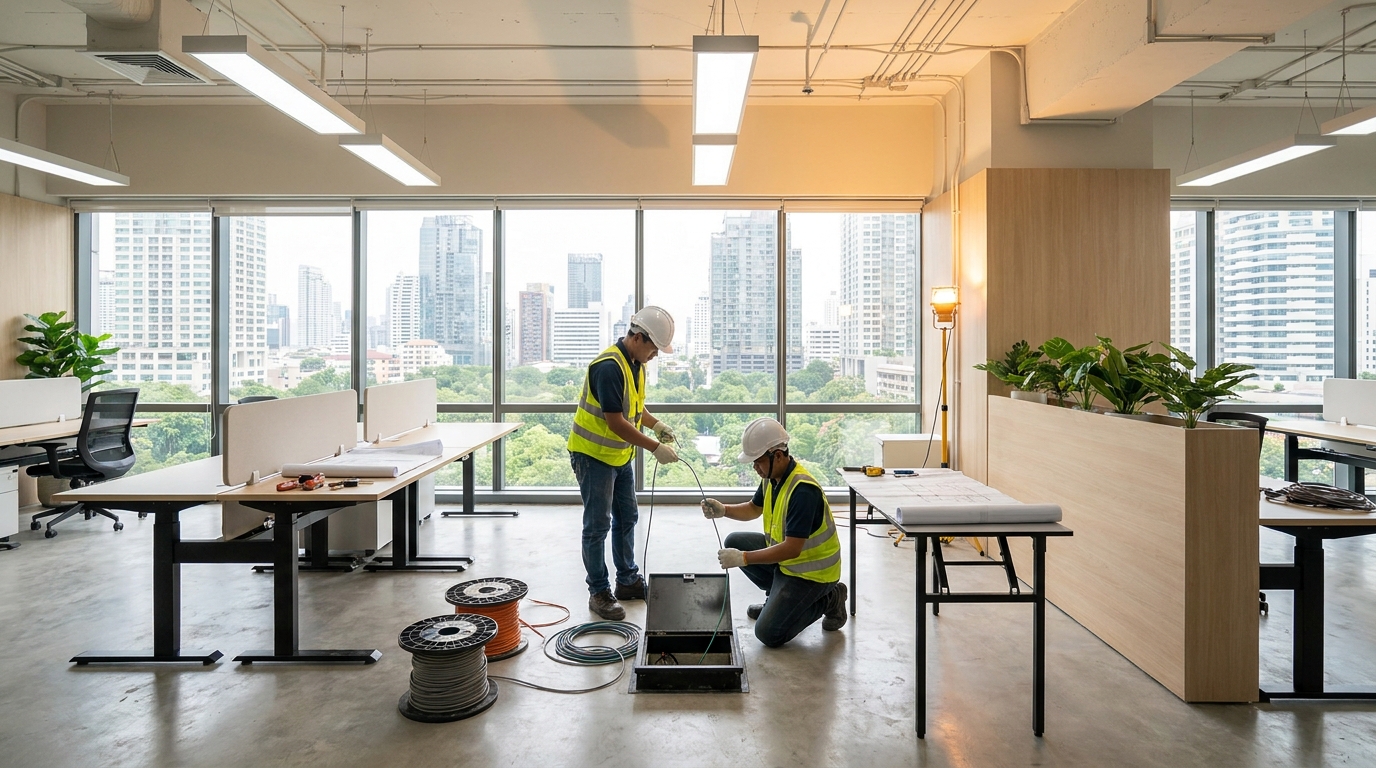
Most office tenants in Bangkok discover their building's electrical limits after they've signed the lease and started the fit-out — which is the worst time. A handful of questions to the landlord or building management beforehand saves money, delay and friction. Here's what to ask.
1. How much power capacity is allocated to my unit?
Buildings allocate power per unit, often by area (e.g. watts per square metre). Modern offices — with dense workstations, server rooms, and supplementary AC — can exceed a tired old allocation. Ask for the allocated capacity in kW or kVA and compare it to your fit-out's calculated load before you commit.
2. Is there a dedicated meter, and who reads it?
Clarify whether your electricity is separately metered and billed, or apportioned by area. A dedicated meter protects you from subsidising other tenants and lets you manage your own consumption.
3. What happens with after-hours air-conditioning?
Central building AC often runs only during office hours; after-hours AC is usually charged separately and sometimes requires advance notice. If your team works late or you have a server room needing 24/7 cooling, this is a real cost and design factor — confirm it early.
4. Where's the tenant electrical termination point — and who owns what?
Establish exactly where the landlord's responsibility ends and yours begins (typically a tenant distribution board on your floor). This defines your fit-out scope and avoids disputes over who pays for the incomer, the DB, and any upgrade.
5. Can the supply take a server/IT room?
If you need a comms or server room, it needs dedicated circuits, possibly a UPS, dedicated cooling, and the ELV infrastructure (data cabling, access control, fire detection) to match. Confirm the building can support it.
6. What are the fit-out rules and approvals?
Buildings have fit-out guidelines, approved-contractor lists, permitted working hours, and a process for approving electrical drawings. Knowing these up front keeps your programme on track.
Get the load calculation done before you sign
The single most useful thing a tenant can do is have an electrical engineer calculate the fit-out's actual load and compare it to the building's allocation — before signing. ETES handles commercial electrical fit-out work across Bangkok and can review a unit's capacity against your plans early. For the contractor-selection side, our 12-point checklist applies to commercial work too.
FAQ
Frequently asked questions
What's the most common nasty surprise in an office fit-out?
Discovering the allocated power capacity can't support the planned workstation density plus supplementary AC and a server room — after the lease is signed. A pre-lease load check avoids it.
Who pays for the tenant distribution board and circuits?
Usually the tenant, from the landlord's termination point inward — but it must be confirmed in writing. The boundary of responsibility is the thing to nail down.
Do I need separate approval for my electrical fit-out?
In most managed Bangkok buildings, yes — drawings are submitted to building management for approval and work follows the building's fit-out rules and approved-contractor list.
Is after-hours AC really worth asking about?
Yes — it's a recurring cost and sometimes a design constraint (e.g. a server room needs 24/7 cooling the central system won't provide). Clarify the policy and cost before fit-out.