
MEA vs PEA Electricity Supply: Which Applies to Your Factory?
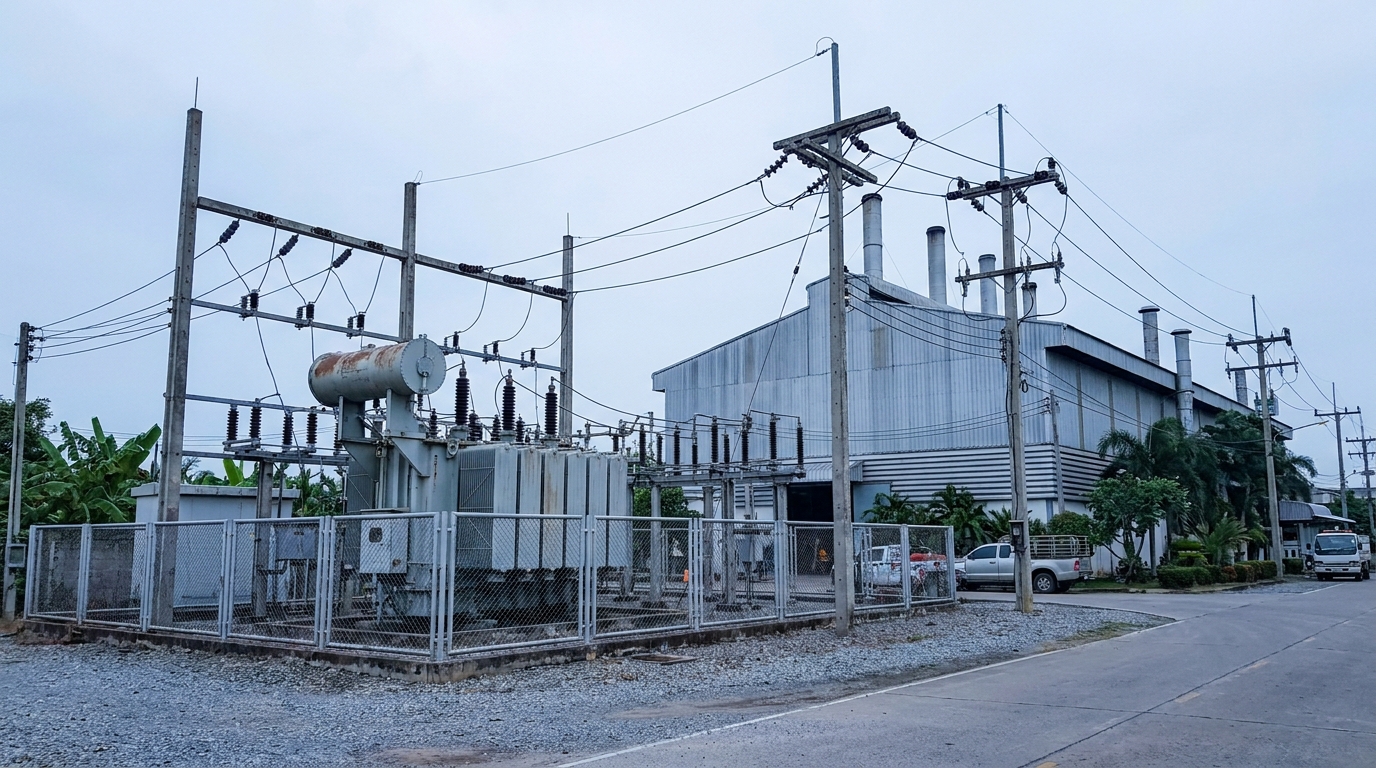
If you're applying for a new electrical supply, upgrading capacity for a new production line, or even just trying to understand who issued your monthly bill, the first question is the same: MEA or PEA?
Most Thai engineers know the answer reflexively. Procurement officers and CFOs at multinational manufacturers, BOI applicants new to Thailand, and tenants moving into a building they didn't commission often don't. This post answers it once, plainly.
The 30-second answer
- MEA — Metropolitan Electricity Authority (การไฟฟ้านครหลวง / กฟน.) — supplies the central metropolitan area: Bangkok, Nonthaburi and Samut Prakan.
- PEA — Provincial Electricity Authority (การไฟฟ้าส่วนภูมิภาค / กฟภ.) — supplies the other 74 provinces, including the entire Eastern Economic Corridor (Chonburi, Rayong, Chachoengsao), Ayutthaya, Pathum Thani, and the rest of Thailand.
- EGAT — Electricity Generating Authority of Thailand (กฟผ.) — generation and the transmission grid; you only deal with EGAT directly for very large industrial loads or direct power-purchase agreements.
So if your factory is in Wang Noi (Ayutthaya), Amata (Chonburi), or Bang Phli (Samut Prakan) — that's PEA, PEA, MEA respectively.
Why it matters in practice
The two utilities run separate application processes, separate fee structures, separate metering programmes, and even slightly different technical requirements for customer substations. The four practical differences plant engineers care about:
1. Application paperwork is different. MEA's customer-substation submissions and PEA's are similar in spirit but not identical in form. You can't reuse a PEA-approved single-line diagram as-is for an MEA project; you'll redraw the title block and adjust to MEA's spec.
2. Tariffs differ slightly. Both utilities charge under the same national tariff structure (ERC-set residential, small/medium/large business, time-of-use), but the demand-charge mechanism and the on-peak / off-peak windows are coordinated nationally — rates change in lockstep, and your bill should look comparable per kWh.
3. Lead times differ. For an upgrade that needs an MV transformer — say a factory expanding from 200 kVA to 500 kVA — realistic application-to-energisation windows in 2026 are roughly 8–14 weeks for MEA and 10–16 weeks for PEA. The variance comes from local provincial workload, not policy.
4. Inspection and energisation procedures differ. The post-installation customer-substation inspection has slightly different documentation requirements between MEA and PEA, and a different inspector workflow. A contractor who runs both regularly will know which is currently faster.
What does ETES handle in each case?
For both MEA and PEA applications, ETES handles end-to-end:
- Load calculation — current and forecast demand, power factor, harmonic profile.
- Customer-substation design — transformer sizing, MV switchgear, MV cable feed-in, earth grid.
- Single-line diagram and documentation in the format required by the relevant authority.
- Application submission to MEA or PEA on your behalf.
- Inspection coordination — chasing the inspection date, walking the inspector through the substation.
- Energisation — switching on and final commissioning tests.
Because we work in Bangkok and across the EEC, our team runs both flows continuously and keeps a current view of which paperwork bottleneck is biting that month.
What you (the customer) need to provide
Whether the application goes to MEA or PEA, you'll need to provide:
- Land documents — chanote / nor-sor-sam-gor / lease agreement.
- Factory licence (รง.4 / รง.6) for industrial sites, or building permit for commercial.
- BOI promotion certificate if you're a BOI-promoted company (often a faster lane).
- Tenant/landlord NOC if the meter goes on a leased site.
- Authorised-signatory documentation for the company.
Common mistakes that delay an MEA / PEA application
After running these applications across Bangkok and the EEC for more than a decade, the same five mistakes keep showing up:
- Underestimating future load. Size the MV transformer for the load you'll have in 5 years, not today. Re-applying to upgrade in 18 months is expensive.
- Single-line diagrams that don't match the actual switchgear. The drawing has to match what's installed. Inspectors check.
- Earth grid not measured. Earth-resistance has to be measured, not estimated, before energisation.
- Missing protective-relay coordination study. For larger customer substations, MEA and PEA both expect a discrimination study with curves.
- Filing under the wrong tariff class. Picking small-business when you should be medium-business (or vice versa) costs money for years. Get a tariff review as part of the application.
When to involve us
Contact us at the design stage, before you start fabrication or place equipment orders. The cheapest hour ETES spends on your project is the one that catches a mistake before it gets cast into concrete.
Frequently asked questions
Can I switch from PEA to MEA (or vice versa)?
Only if your physical address sits in the other utility's territory — and that depends on geography, not preference. Some borderline addresses near Bangkok-Nonthaburi sit on the seam, but it's uncommon.
My factory has both MV and LV supply — do I deal with both authorities?
No, just one. Whichever utility owns the territorial supply also handles your MV connection.
What about EGAT direct-power purchase?
EGAT direct-purchase makes sense for very large industrial loads (typically 25 MW+) and for green-tariff direct PPAs. For most factories below that scale, you stay with MEA or PEA.
Does ETES charge separately for the MEA / PEA application work?
We bundle the application work into the substation-design scope, so it's part of the substation engineering rather than a separate line. We can also handle the application as a stand-alone scope if your existing engineer already designed the substation.